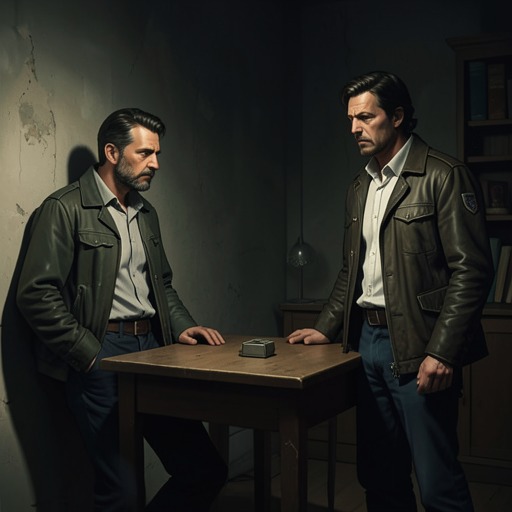
The friendship and hierarchical relationship between Elijah Baley and Julius Enderby
The Caves of SteelThe friendship and professional relationship between Elijah Baley and Julius Enderby joins an old college attachment to the unequal machinery of the police hierarchy. Enderby’s rise to Commissioner gives him the authority to place Baley in charge of the Sarton investigation; his personal loyalty helps make that opportunity possible, but also makes the assignment a favor with institutional and political stakes.
Origins and Diverging Careers
Enderby was two classes ahead of Baley at the City School of Administrative Studies. They became friends, and when Baley completed his aptitude tests and neuroanalysis and entered the police force, Enderby was already there, established in the plain-clothes division. Baley followed, but at an increasingly greater distance. The difference was not presented as a simple contest of ability: Baley was capable and efficient, while Enderby possessed a particular ease in the administrative system.
Enderby fit the bureaucracy. He was comfortable in a hierarchy, smooth with other people, careful not to offend, and able both to take orders gracefully and to give them with a balance of gentleness and firmness. Baley regarded him as no great intellectual, and noticed his childish peculiarities, including intermittent, conspicuous Medievalism. But Enderby’s social fluency and ability to get along with the Spacers made him useful to the City. In a Civil Service that rewarded smooth cooperation more reliably than individual competence, he rose quickly to Commissioner while Baley remained a C-rated detective.
Friendship Within the Hierarchy
Their professional difference did not erase their earlier closeness. Enderby did not forget that they had been friends, and, in Baley’s understanding, tried in his own peculiar way to compensate for the disparity created by his success. That effort carried an ambiguity: Baley could regret the widening gap between their careers without resenting Enderby for it, while recognizing that a favor from the Commissioner was also an exercise of rank.
When the investigation is assigned, Enderby calls Baley a friend and recalls that they went to college together. He acknowledges that his position as Commissioner can make it seem as though he has forgotten their personal bond, then insists that the friendship remains. His selection of Baley is therefore not presented as a purely impersonal appointment: Enderby wants his friend to have a chance, even as the opportunity depends on the authority of the office he holds.
The Investigation as Favor and Test
Enderby appoints Baley the operative in charge of the murder investigation. Baley objects that he is only a C-5, and points out that several men in his section have higher ratings. His hesitation registers how unusual the decision is: Enderby does not ordinarily step outside protocol in this way except in an extreme emergency. The appointment thus combines professional confidence with a breach of ordinary procedure.
Enderby gives two reasons for choosing him. The first is friendship and the belief that this is a tremendous opportunity for the right person. The second is that Enderby believes Baley is his friend and asks him for a favor in return: Baley must accept a Spacer as his partner. The Spacers have agreed not to report the murder and to leave the investigation in the City’s hands, but only on the condition that one of their agents participate throughout. Their bargain makes the partnership both a practical condition of the case and a political obligation, not a personal preference Baley can simply decline.
Baley understands that the assignment could bring a major advance, though it is tough and unpleasant. He also sees that Enderby’s appeal to friendship and need masks, without concealing, the power to give the opportunity to somebody else. The favor therefore runs in both directions: Enderby uses his authority to advance Baley, and asks Baley to accept a difficult arrangement required by the Spacers.
Meaning and Limits of Their Bond
Baley’s recollection gives their friendship a texture of affection without denying its inequalities. Enderby’s rise reflects a form of institutional competence that Baley lacks, while Baley’s slower progression does not amount to failure or incapacity. Enderby tries to make up for his advantage through practical assistance, but the assistance remains inseparable from rank: he can give Baley the investigation precisely because he has become Commissioner.
The relationship consequently frames Baley’s assignment as both recognition and obligation. Enderby’s friendship helps him choose Baley over more highly rated detectives; the Spacer condition turns that choice into a demanding task with consequences beyond their personal history. Their old bond survives inside the hierarchy, but it cannot make the hierarchy disappear. Instead, the investigation exposes how friendship operates through it: as genuine loyalty, as an unusual use of authority, and as the basis for asking a friend to shoulder a politically sensitive responsibility.